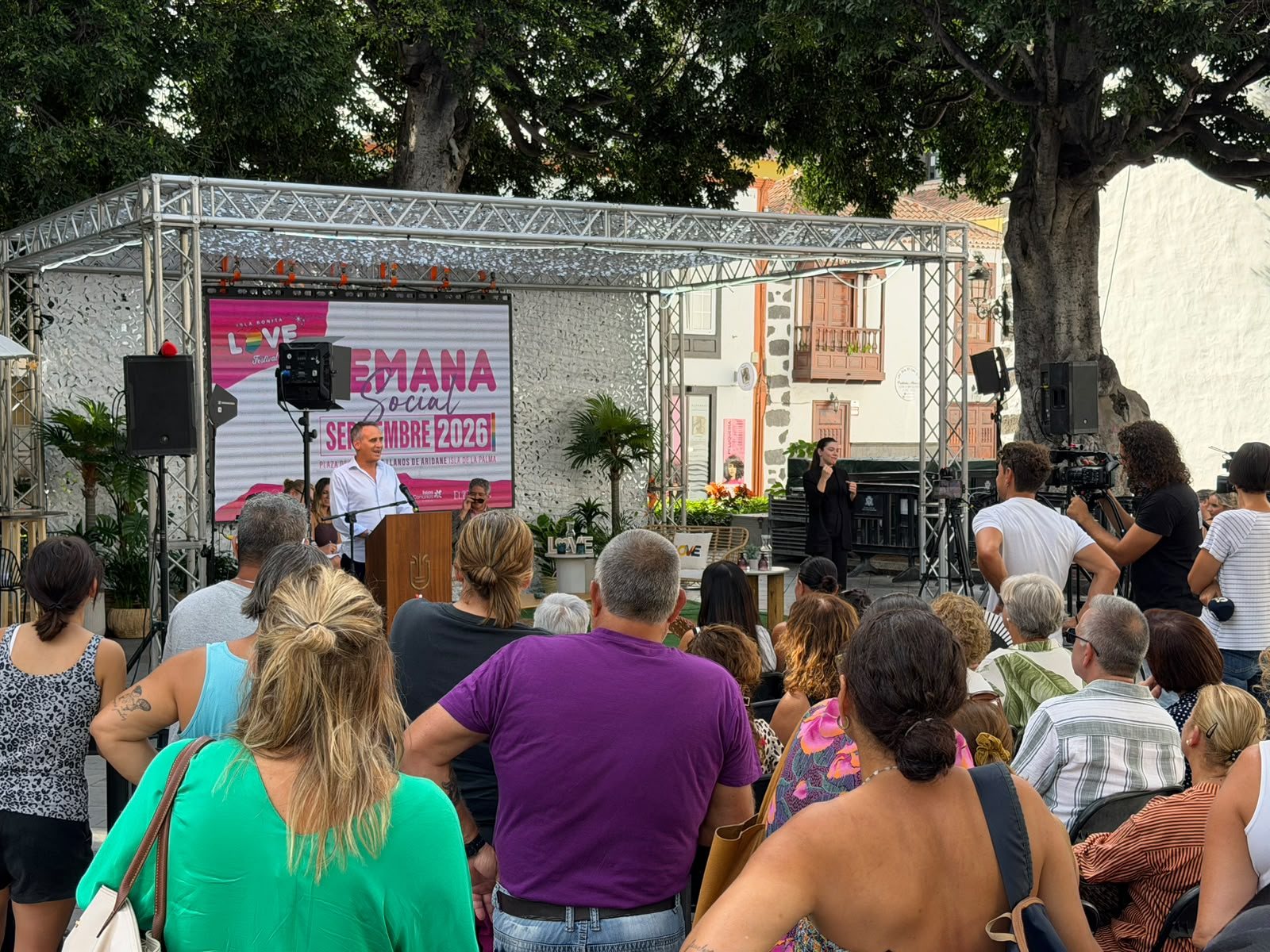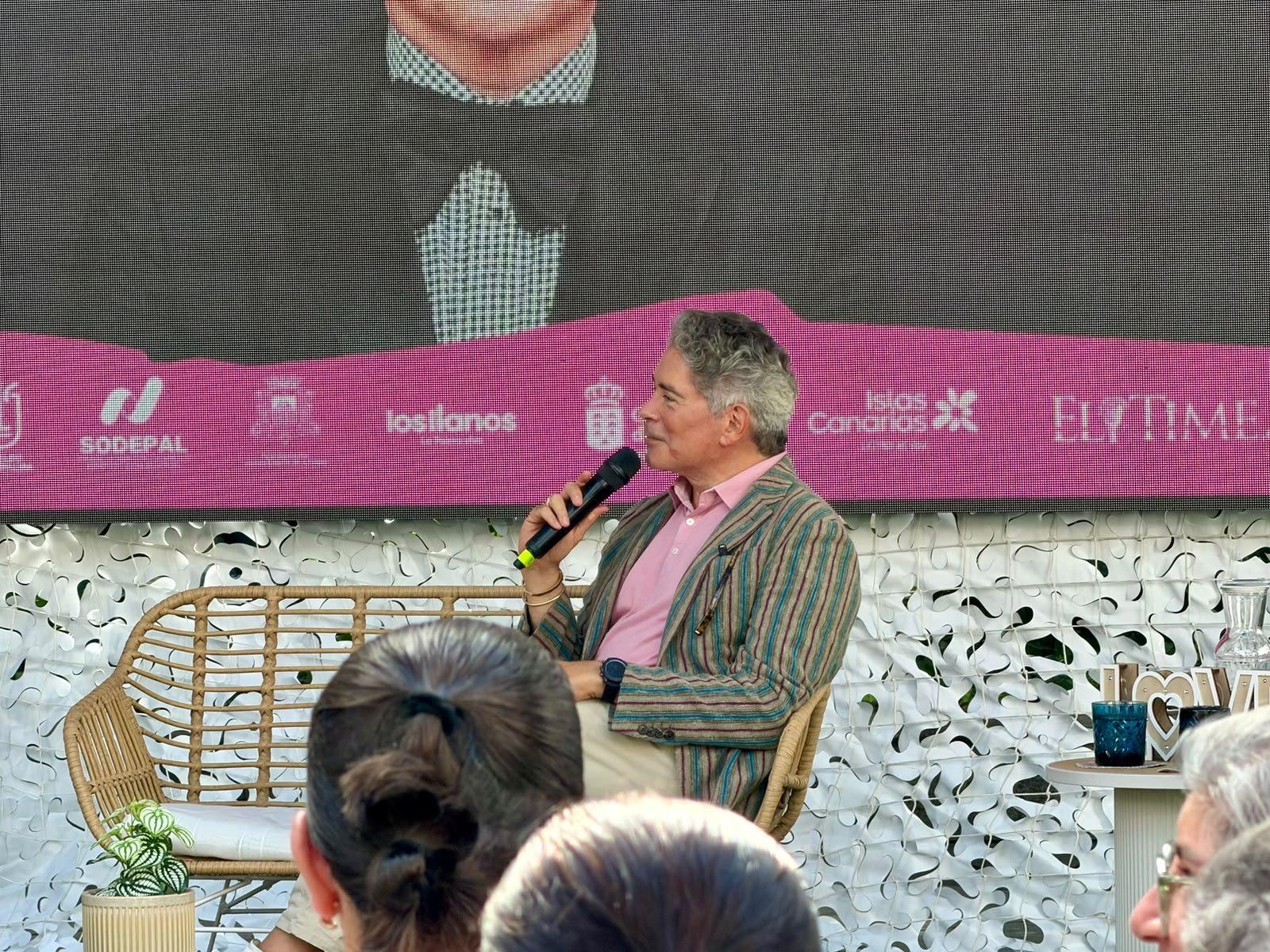

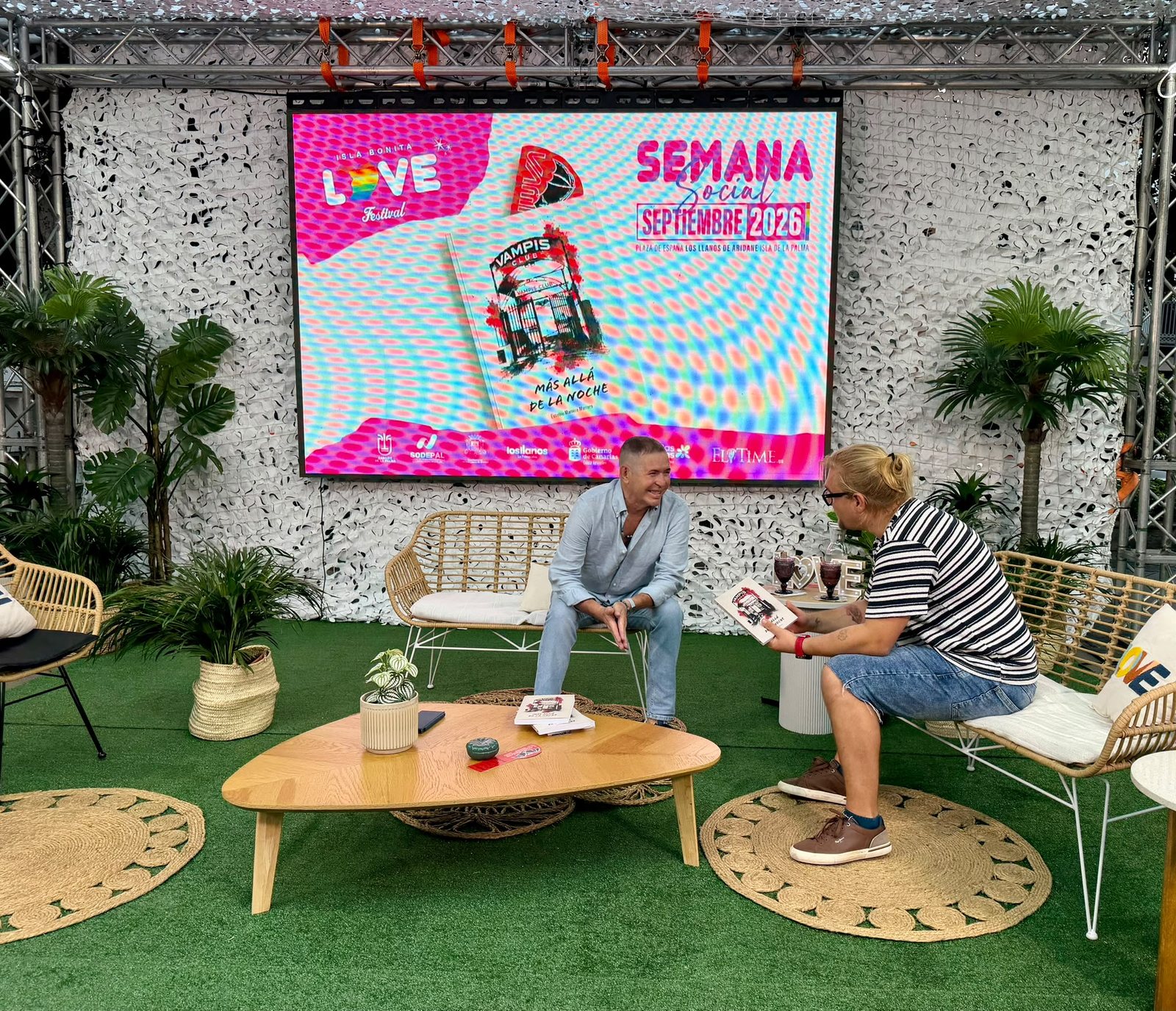
The Isla Bonita Love Festival Social Week opened its programme on Tuesday 15 September in the Plaza de España in Los Llanos de Aridane with a day focused on diversity, LGBTIQ+ activism and migration experiences. The agenda included a talk with Boris Izaguirre, the 10th Political and Social Convention, held under the title “LGBTI+ Activisms across Continents”, and the presentation of the book Vampis, más allá de la noche.
The opening event was attended by the Cabildo de La Palma’s councillor for Economic Promotion, Miriam Perestelo, and the mayor of Los Llanos de Aridane, Javier Llamas. Perestelo defended the social dimension of the festival and the right of everyone to live their identity freely. “We want an island where nobody has to hide who they are,” she said.
For his part, Llamas thanked the Cabildo de La Palma and the public company Sodepal for their continued commitment to this programme and to holding it in the municipality.
Watch the sessions live on YouTube
From television to activism: Boris Izaguirre’s perspective
The talk with Boris Izaguirre, hosted by journalist Javier Rodríguez, looked back at the writer and broadcaster’s television career, the visibility of homosexuality and his experience as a Venezuelan migrant in Spain. Izaguirre recalled how he gradually became aware of what his everyday presence on Crónicas Marcianas meant, and highlighted the role of Javier Sardá in opening up that television space to him.
He also recalled being present in the Spanish Congress of Deputies when same-sex marriage was approved, and described his path into activism as a learning process. “It’s not an activism I was born with. I’ve grown into it, and I celebrate that,” he said. With a mix of humour and personal memories, he championed coexistence over polarisation and explained that having two countries means, for him, having two cultures.
His migration experience served as a bridge to the convention that followed. Izaguirre acknowledged that, unlike other migrants, arriving in Spain with a contract as a scriptwriter made it easier for him to settle in the country, having left Venezuela partly out of a desire to build his love life in freedom.
Activisms across continents
After the conversation with Boris Izaguirre, the panel was joined by Djedje Batlle, a gay Ivorian activist, PhD candidate in Anthropology at the Autonomous University of Madrid and researcher on homosexuality, Christianity and the experiences of gay African men; Mahmud Assy, an Egyptian queer activist, refugee in Spain and founder of Eufonía Diversity; and Alfredo Pazmiño, a gay Peruvian activist, migrant in the Canary Islands, anthropologist and expert in international LGBTI+ cooperation with more than fifteen years of experience in the field.
Anthropologist Alfredo Pazmiño warned that hard-won rights must not be taken for granted and linked the situation facing the community in Peru to the rise of fanaticism and political radicalisation.
Drawing on his own experience, Djedje Batlle stressed the diversity of realities across the African continent. Originally from Côte d’Ivoire, he pointed out that the possibility of living openly depends on one’s family environment, resources and social position: “Everything depends on your social situation and your privileges.” He also argued that racism must be tackled as a structural problem, beyond individual behaviour.
Mahmud Assy described how homosexual people are persecuted in Egypt through the application of other laws and denounced the police’s use of fake profiles on dating apps. He also spoke about the difficulties of being received in Spain, calling the asylum system “dehumanising” and demanding that it be built around the dignity and participation of migrants themselves.
The conversation thus explored how racism, precariousness and discrimination based on sexual orientation or gender identity can build up within a single experience.
The convention also featured a video message from Alexandra Andino, a Honduran activist and coordinator of the trans area at Acción Triángulo. Although she was ultimately unable to attend in person, she spoke about the violence and structural discrimination against LGBTIQ+ people in Honduras and stressed the need to keep denouncing these situations publicly.
The day ended with the presentation of Vampis, más allá de la noche, by Eusebio Marrero, led by José Manuel Placeres Trujillo, owner of the venue that inspired the book. The book recovers the memory of the iconic establishment in Puerto de la Cruz, which became a reference point for the LGBTIQ+ community and a witness to the evolution of its freedom and visibility.
Presentation of the book ‘Vampis’
Acknowledging the lack of women on the panel
During the session, the host of the programme, Javier Rodríguez, expressly acknowledged, on behalf of the organisers, the mistake of having no women among the in-person participants at the convention. He explained that efforts had been made to include Alexandra Andino and María Isabel Obono, a bisexual woman from Equatorial Guinea and a refugee in Spain, but that in the end their contributions could not go ahead due to scheduling reasons.
Rodríguez also noted that the illness of Isabel Pantoja, patron of this year’s social programme, had forced the cancellation of the opening event planned for Monday, which also disrupted the start of the programme. In this context, he described the lack of a greater female presence as a failure shared by those responsible for the event.
He also recalled that in previous editions the programme had featured broad participation from the community and defended the work carried out over the festival’s ten years, while insisting on the need to acknowledge mistakes when they happen.
Along these lines, he stressed that the programme would continue on Wednesday 16 September with the Atlantic Forum on Human Rights, a working meeting bringing together institutions and representatives of the different realities within the LGBTIQ+ community. During the meeting, the contents of the La Palma 2026 Declaration would be defined ahead of its public reading.