
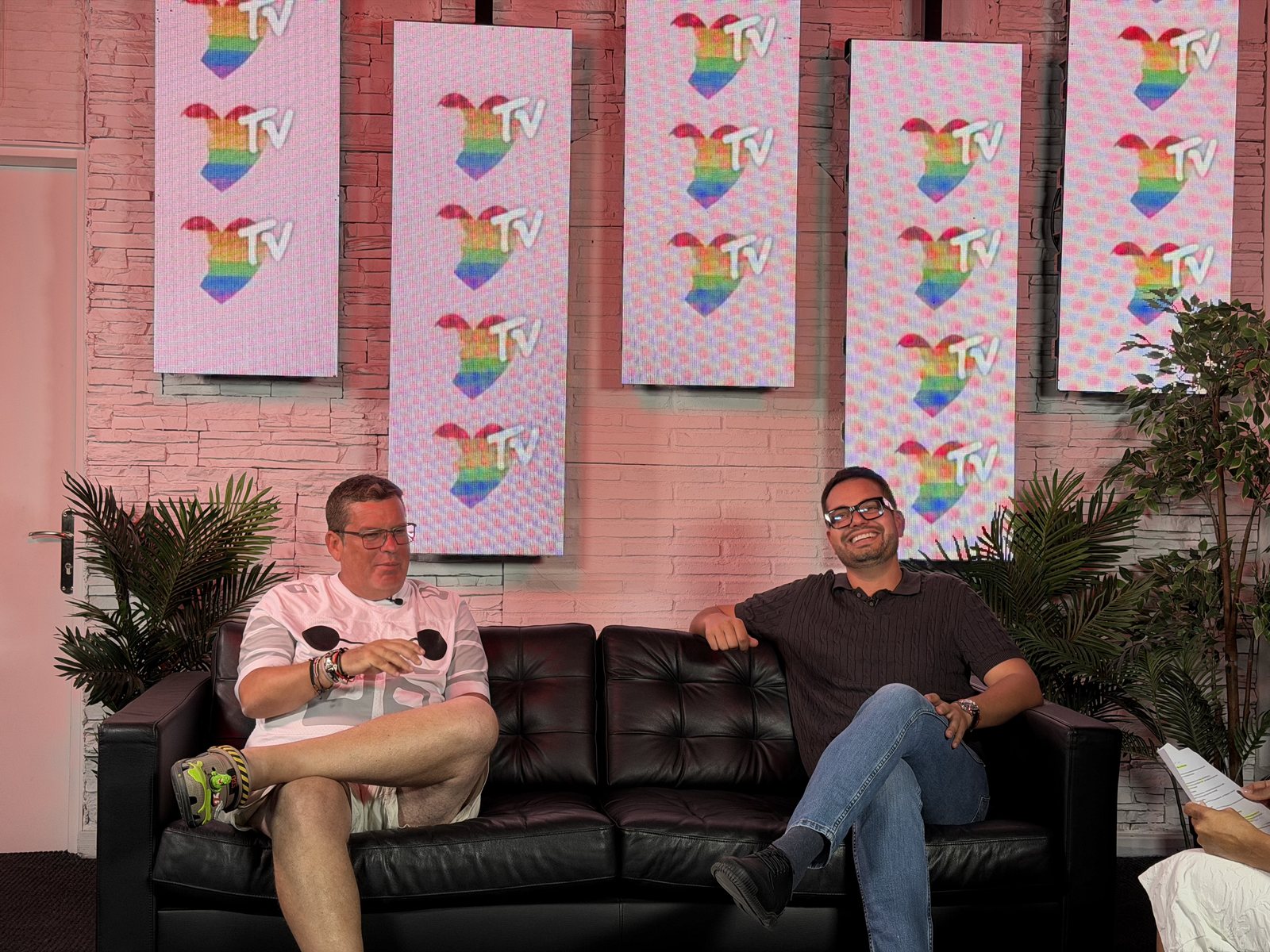
Watch the interview on LOVE TV
Ten years ago, promoting a public agenda in La Palma centred on sexual diversity, equality and LGBTIQ+ rights meant opening a public conversation that barely had a space of its own. That is precisely where the Isla Bonita Love Festival was born, long before the big stages, the international artists and the thousands of people at the Port of Tazacorte became its best-known image.
A decade later, Jordi Pérez Camacho, the island councillor for Economic Promotion when the project began, and Maikel Chacón, the event’s artistic director and producer, piece together a story of successes, controversies, political changes, production challenges and situations that were never known to the outside world.
First came the message, then the big concert
The Love, Pérez Camacho explains, was born in two stages. In 2016, the initial idea was to combine economic promotion with messages of “tolerance, respect and equality”, using the drawing power of the activities to bring diversity into the island’s public conversation.
The big musical leap came a year later. Maikel Chacón still remembers the meeting at the Cabildo where Jordi was very specific: around 90,000 euros were initially on the table to develop the event. The proposal ended up growing much bigger. Miguel Bosé, the event’s first artist, was followed by other big names, and the Port of Tazacorte became the stage on which the musical dimension that accompanies the festival today began to take shape.
Then came Maná, one of the moments Chacón remembers as a real turning point. Not only for getting a band of that stature to play in La Palma, but for seeing them sit in front of the media and speak openly about sexual diversity and the reality of the LGBTIQ+ community in Mexico. For the producer, it showed that artists were beginning to understand that there was something more behind the concert. “That’s an achievement, a big achievement,” he recalls.
The other side: “Here comes that faggot of a councillor”
Those early years were not easy either. Jordi Pérez Camacho recounts that opposition to the project was not limited to political debate; he even received comments such as “Here comes that faggot of a councillor”.
He places episodes of this kind during his time in politics between 2015 and 2019 and acknowledges that those years were marked by pressure that sometimes went beyond criticism of his management.
One of the arguments that followed the Love from its early years was its cost. Pérez Camacho maintains that, after he left the governing group in 2019, the accounts from his term were subjected to three audits. “The Isla Bonita Love Festival is the most audited festival in the Canary Islands,” he says.
All this despite the fact that those analyses also showed that the economic impact of the event multiplied each euro of public investment by at least three, according to the audits carried out after he left the island government.
José Luis Perestelo was “the most unfair and the fairest person”
Over this decade, the Love has gone through several political changes, often accompanied by doubts that have periodically surrounded the festival’s continuity or the way it is run.
Even so, it is within that first stage that Jordi Pérez points to one name in particular: José Luis Perestelo. He describes him, paradoxically, as “the most unfair and at the same time the fairest person” he met along the way.
Pérez Camacho recalls that convincing him was not easy. “It took blood, sweat and tears for José Luis to understand me,” he says. However, he explains that once Perestelo understood the project, “he put himself right at the front” and became one of its strongest political advocates to ensure it went ahead. “I only have words of gratitude for him,” he concludes.
“I dare them to scrap the Love”
Maikel Chacón is particularly forthright when it comes to the debate over public money. His position is that if a future government considers that La Palma should not invest public money in an event of this kind, it should take political responsibility for that decision. “They don’t want the Love Festival because it costs money… Then scrap it,” he goes so far as to say.
For Chacón, what “makes no sense” is for a project to be permanently subjected to the same economic debate from the opposition every time the government changes, despite the audits and its value as a tourist attraction. He also questions the way spending the cultural budget is constantly pitted against needs in other areas.
The producer gives housing as an example and considers it unfair to blame the Culture or Economic Promotion departments for spending the funds allocated to them while, he argues, other public budget lines do not reach the same levels of execution.
His view is that each department should be accountable for managing its own resources, and that spending the budget earmarked for events does not prevent the housing, roads or other services budgets from being spent.
Changes of government
The public sees the finished stage. What happens before is another story. Among the anecdotes in the interview, Jordi Pérez recalls a particularly complicated edition in which time was running out and the Love had still not confirmed one of its headliners. They were at Fitur in Madrid, and March was approaching. Chacón ended up going around the tourism fair itself in search of the manager of a well-known band to try to close a booking right there and then.
Today, the festival’s growth means working further and further in advance, and the producer explains that certain artists have to be booked almost a year ahead. This creates a clash between the timelines of the music industry and those of electoral processes and public administration.
If the aim is to secure certain names for the following summer, he argues, negotiations have to take place before the budget for the year in which the event will be held has even been approved. And that is where another uncertainty comes in: changes of government. “What’s going to happen with the change of government? Who’s going to come in? What are they going to do? What will they think of the Love?” Chacón asks.
The producer may find himself committing to an artist months in advance without knowing what position those in government will take when the time comes to stage the festival.
“The fanfare, yes, but you have to be there”
After ten years, both agree on one thing: music has a drawing power that is hard to match, and that creates a paradox.
The concert was born as a tool to amplify the social message, but it ended up becoming far bigger than any debate, conference or meeting organised within the Social Agenda itself.
Chacón then puts a question to La Palma’s political class: “How many mayors, councillors and island councillors actually sit down to listen to those debates?” He recalls, for example, this year’s talks and asks how many public representatives were there listening to messages about equality or diversity. “The fanfare, yes, but you have to be there and believe in things,” he says.
Jordi immediately chimes in with another question: “Who’s missing at the concert?” And both raise another of the contradictions they say they have observed over the years: invitations.
Asked whether those who have criticised the festival also turn down tickets, Chacón is blunt: “Here they ask as if there were no tomorrow.”
The producer even reproduces the kind of requests he says he receives: “Give me my ticket, give me my pass, and make them good ones,” questioning how much the social background or the earlier criticism of the event really matter at those moments.
So while the Social Agenda meetings struggle to bring together institutional representatives, the concert draws audiences, cameras, political presence and, according to Chacón, numerous requests for invitations too.
For Pérez Camacho, this difference highlights one of the project’s unfinished tasks. He argues that the Social Agenda should stop being concentrated in a single week and gain continuity throughout the year through public equality and social services policies.
Even so, he believes these ten years have already brought about important changes. Among them, he highlights the birth of an LGBTIQ+ association in La Palma and the consolidation of the public Pride celebration, two processes he links to the path opened up by the festival and its social side.
Bob Pop looking for a party and backstage secrets
Ten years of the Love have also left a collection of stories that could hardly be known from the other side of the stage. One of the most curious starred Bob Pop, who was in La Palma to take part in the Social Week.
Jordi remembers getting a call one night from the Local Police. They told him that the writer and TV contributor was going around Los Llanos looking for an open bar to carry on the night. Pérez Camacho did not quite understand what the problem was. “Let the man be happy,” he replied.
Maikel Chacón has even more production stories. One of the requests that surprised him most came with Maná’s drummer. His dressing room had to be completely lined in black and decorated with various items that caught the producer’s attention when he walked in. “It was a really strange dressing room. I’ve never seen anything like it,” he recalls.
But probably no request has stuck in his mind quite like Alejandro Sanz and the Maldon salt. The production team had precise instructions to place that specific salt in the dressing room.
After months of searching, they could not find it, and the team even came up with a very La Palma solution: replacing it with salt from Fuencaliente, vouching for the quality of the local product.
None of the solutions worked, but the situation was resolved when the manager opened her own suitcase. Inside were numerous jars of Maldon salt. She took one out, placed it in the dressing room and told Chacón: “My job is to demand it from production, but I always bring some in my suitcase.”
Ten years on, “it walks on its own”
Jordi Pérez Camacho talks about the Love like someone looking from a distance at something he felt was his own for years. Not anymore. “Seeing that it walks on its own and that it belongs to many people makes me feel good,” he admits.
Letting go of that sense of parenthood, he explains, has allowed him to accept that the festival can evolve, change and find other ways of doing things without depending on those who were behind its first steps.
Pérez Camacho says that he can now look back and see that the project is strong enough to outlive its own creators. “The festival has its own identity and doesn’t need anyone,” he says. “What it needs is for there to be people at every moment who are determined to keep the festival going.”
Maikel Chacón also looks ahead to the next decade and cites as one of the challenges getting La Palma to fully embrace the Love as its own project, regardless of who is in government or who is in charge of organising it.
Between the bet that began ten years ago and today’s festival lie international artists, audits, political changes, last-minute crises, social debates and a long list of stories that never reached the public.
But now they no longer need to claim whose project it is. The Love walks on its own.